Reading a lead
Clicking a name on the quote list opens the lead. Everything the customer told the calculator is on this one screen, in the order you need it on a call: the roof first, then their answers, then the system they built for themselves.
The point of the layout is that you should be able to say “you could take ten panels, not eight” before you dial, rather than discovering it halfway through a second conversation.
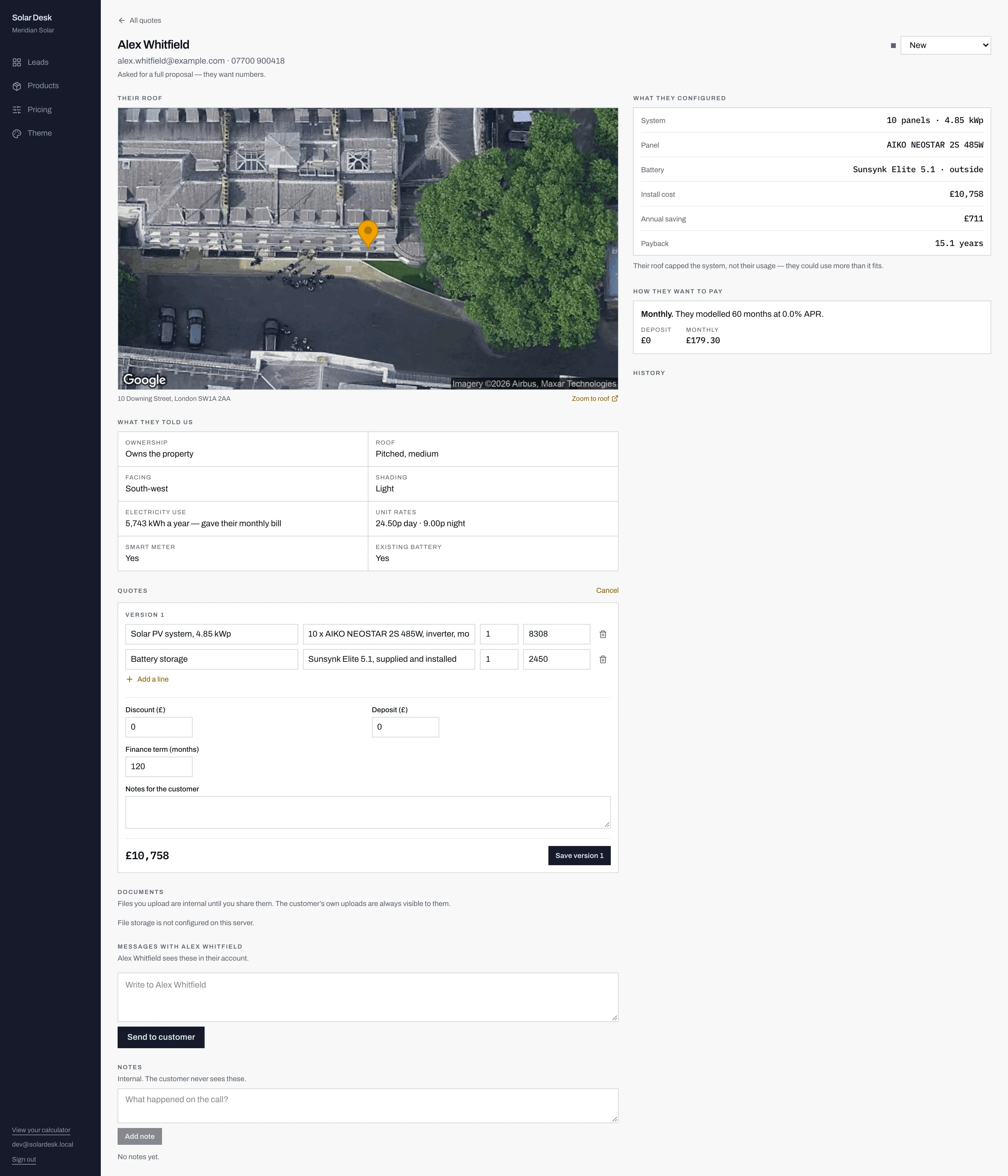
- The line under the contact details says which of the two things they asked for. It changes what your first action should be.
- The status picker. Any status can be chosen here, and the change is added to History rather than replacing what was there.
- The satellite view sits above everything else on purpose, with the customer's own marker on it.
- The right-hand column is the system they configured, how they want to pay for it, and everything that has happened to the lead.
The header
Section titled “The header”Under the name sit the email address and the phone number, then one line that tells you what kind of lead this is:
- “Asked for a full proposal, they want numbers.” They chose the written route. They expect something itemised, in writing, and a phone call that starts by reading the estimate back to them will feel like a delay.
- “Asked for a callback, they want a person, not a document.” They chose to talk. Something is unresolved, and sending a PDF answers none of it. These are also the leads tagged wants a call on the quote list.
If they told the calculator when to reach them, a “Prefers:” sentence follows, in their own words, along the lines of “weekday evenings” or “after 6pm”. It is free text, so read it rather than filtering on it.
The status picker sits on the right of the header. See moving a lead through the pipeline.
The low-confidence banner
Section titled “The low-confidence banner”If the customer answered “I honestly don’t know” when the calculator asked about their electricity use, a banner appears under the header:
Low confidence. This customer did not know their electricity use, so the figures below are built on a typical home of this size, not on their own consumption. Worth confirming first.
It is not a warning about a broken lead. Not knowing your annual usage is a completely normal thing for a homeowner, and the calculator treats it as a real answer rather than making one up quietly. The banner exists so that you know the saving and the payback on this particular lead rest on an assumption, and that “can you find last year’s statement?” is a better opening than a price.
Their roof
Section titled “Their roof”A satellite image of the property, centred on the marker the customer dragged onto their own roof. Underneath it are the address they picked and a Zoom to roof link, which opens the same spot in Google Maps where you can zoom, tilt and measure properly.
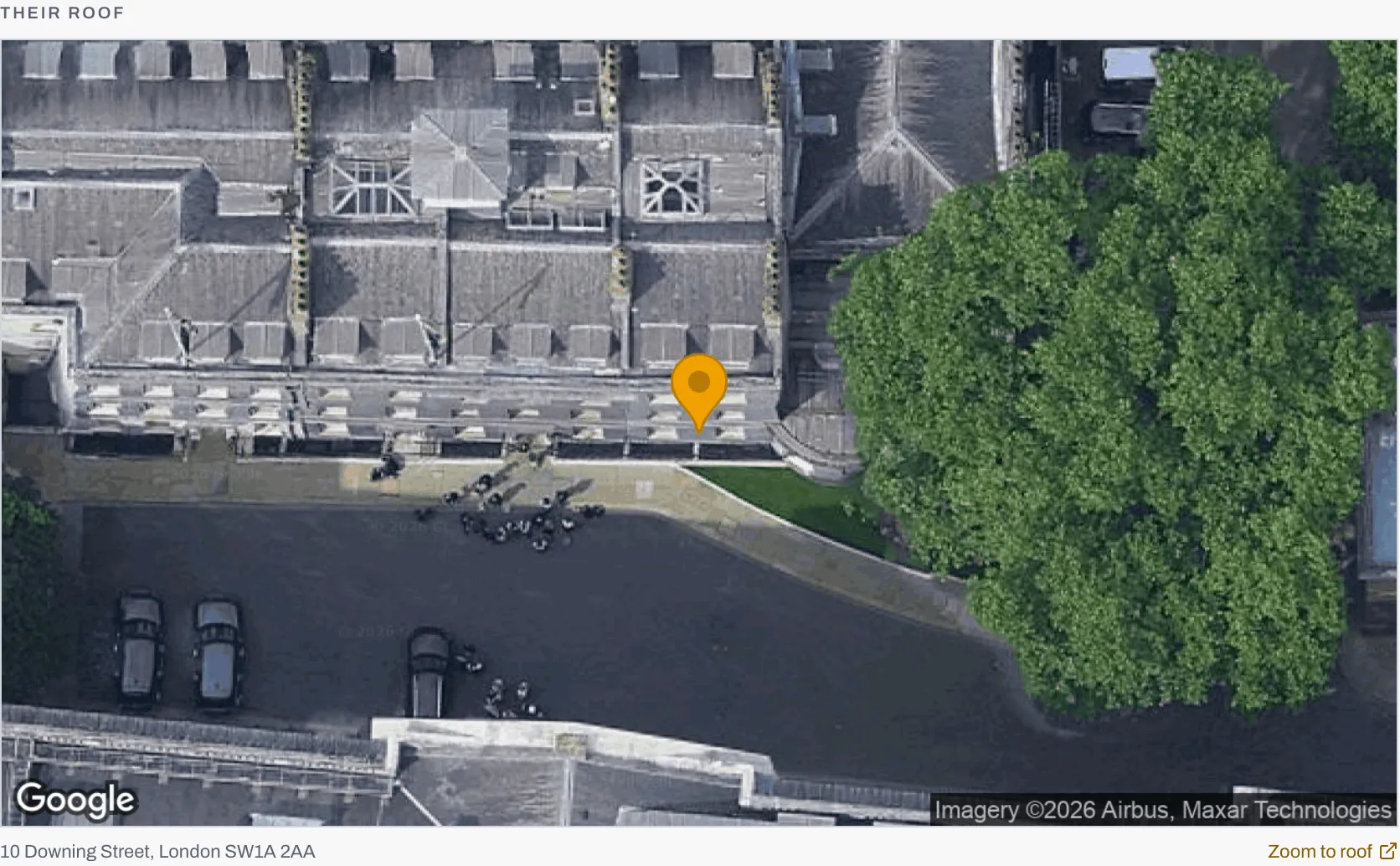
- The marker the customer dragged onto their own roof. The picture is centred on the pin, not on the address.
- The address they picked from the lookup.
- Zoom to roof opens the same spot in Google Maps, where you can tilt and measure properly.
The marker matters more than it looks. Satellite pictures go out of date, terraces confuse address lookup, and a new build can still be showing as a building site. The customer put the pin on the roof they want panels on, so the picture is of the right building even when the address is ambiguous.
If the lead has no location on it, the panel says so and gives whatever address was typed. The estimate still stands; the map simply had nothing to draw.
What they told us
Section titled “What they told us”Their answers from the first three steps of the calculator, as given.
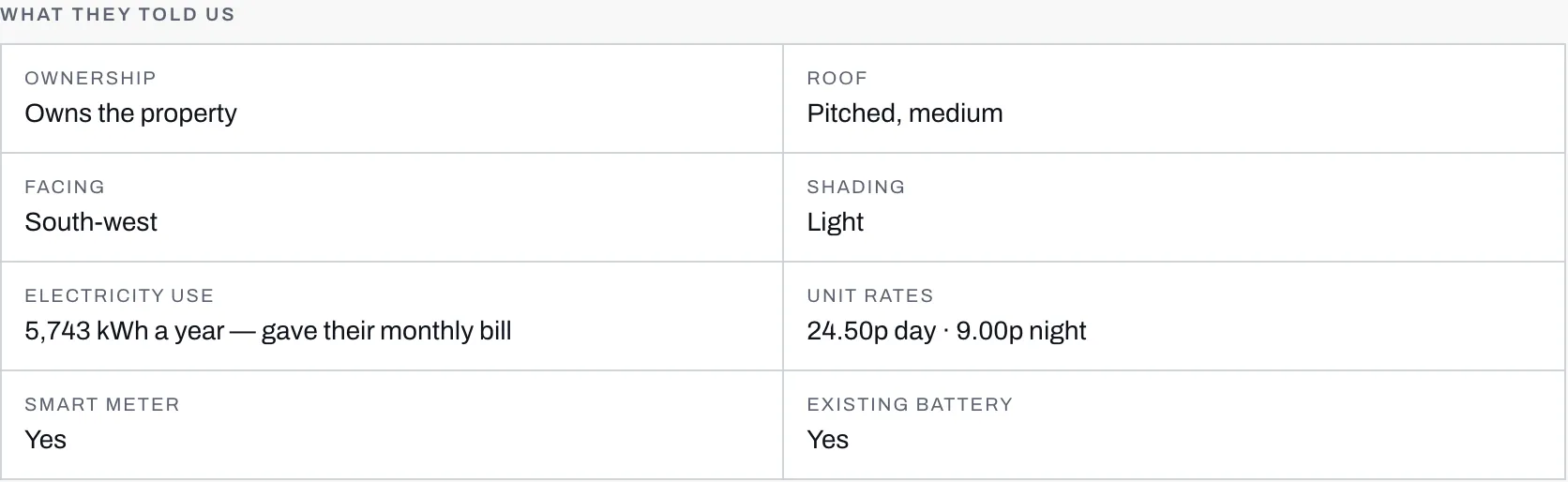
| Field | What you will see |
|---|---|
| Ownership | “Owns the property”, or a note that they let it out, which is a different sale rather than a disqualification |
| Roof | Shape and size band, for example “Pitched, medium” |
| Facing | A compass direction, or “Not stated, south assumed” when they were not sure |
| Shading | None, Light, Moderate or Heavy |
| Electricity use | Annual kWh, followed by how they arrived at it: gave their annual kWh, gave their monthly bill, picked a usage band, or did not know |
| Unit rates | Day rate and night rate in pence, or “Not given” |
| Smart meter | Yes or No |
| Existing battery | Yes, No, or Not sure |
“Not stated, south assumed” is worth reading carefully. It does not mean the roof faces south. It means nobody knows, the estimate assumed the best case, and a west-facing roof will come in lower than the figure they have already seen.
What they configured
Section titled “What they configured”The system the customer built for themselves on step 4, and the four figures they were shown.
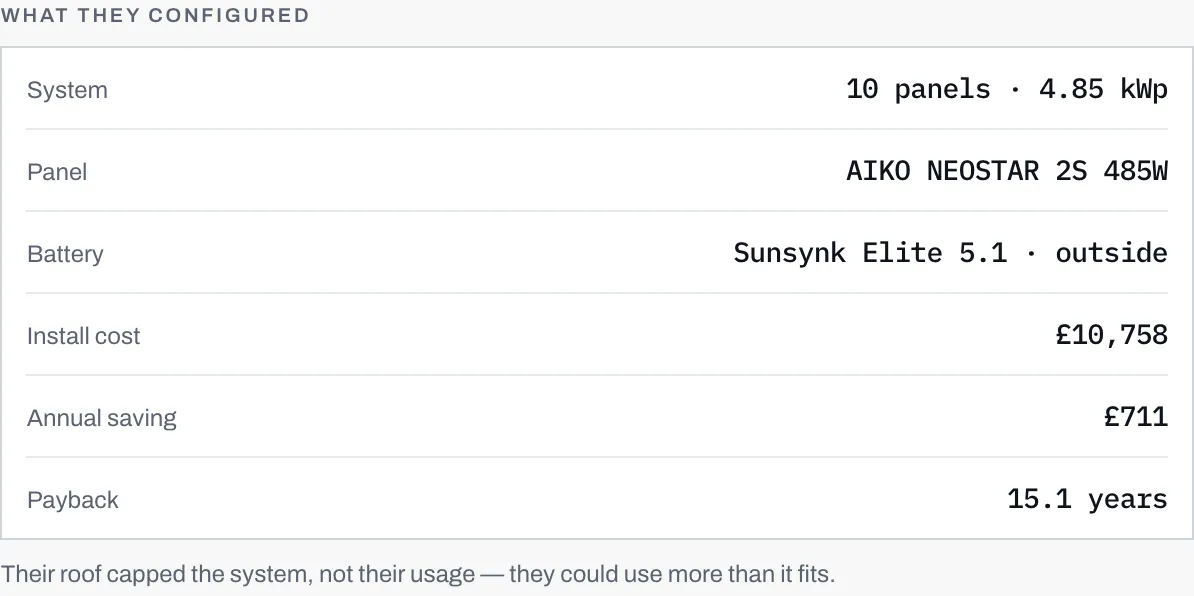
- The battery, named, and with the place they said they would put it.
- The roof-limited flag, in small type under the table. Their usage would justify more than the roof fits.
The rows are the system size and panel count, the panel model, the battery model and where it would go, then installation cost, annual saving and payback. Payback reads “Not recoverable” rather than a number when the system never pays for itself on the figures given.
Two flags can appear underneath, and both are conversation openers.
“They moved off the recommendation of N panels and chose M.” The customer deliberately changed the size, and they know they did, because the calculator told them so at the time. Ask why. Somebody who dropped from ten panels to six usually has a budget in mind, and somebody who went up usually has an electric car or a plan for one.
“Their roof capped the system, not their usage, they could use more than it fits.” The slider hit its ceiling before their consumption did. This is the lead where a site visit is worth more than a phone call, because the roof measurement in the estimate is a rough band and yours will be better.
How they want to pay
Section titled “How they want to pay”The customer chose between a one-off payment and an instalment plan on step 5, and the choice is saved so that you see the same thing they did.

“One-off payment.” A cash buyer, and a genuinely different conversation. Nothing about credit needs to come up.
“Monthly.” Followed by the term and APR they modelled, then the deposit and the monthly instalment they were shown. They have already seen a monthly figure, so quoting a different one without explaining why is the fastest way to lose them. If your quote changes the term or the deposit, say so.
History
Section titled “History”Every status change on the lead, in order, as “From, then To”, with the date and the person who made it.
An enquiry that has never been touched has an empty history. The list records changes, and arriving is not a change, so the first line appears the first time somebody moves the lead off New.

Changes are recorded rather than overwritten, so a lead that went New, then Contacted, then Lost, then Interested again keeps all four entries. Automatic moves appear here too, without a name against them, because nobody at your company made them.
What else is on the page
Section titled “What else is on the page”Below the roof and the answers, in order:
- Quotes, where you build, send and amend a quotation.
- Documents, covered in files on a job.
- Messages and Notes, which look similar and are nothing alike. Read notes and messages before you use either.