The quote list
Quote management, at solardesk.app/leads, is where you land when you sign
in and where most of your team will spend their day. One row per enquiry
somebody finished on your calculator, newest first, with enough on each row to
decide who to ring without opening anything.
The dashboard always wears Solar Desk’s own colours. Only the customer-facing side is branded as you. The demo installer in these screenshots is called Meridian Solar, and every price in them is invented.
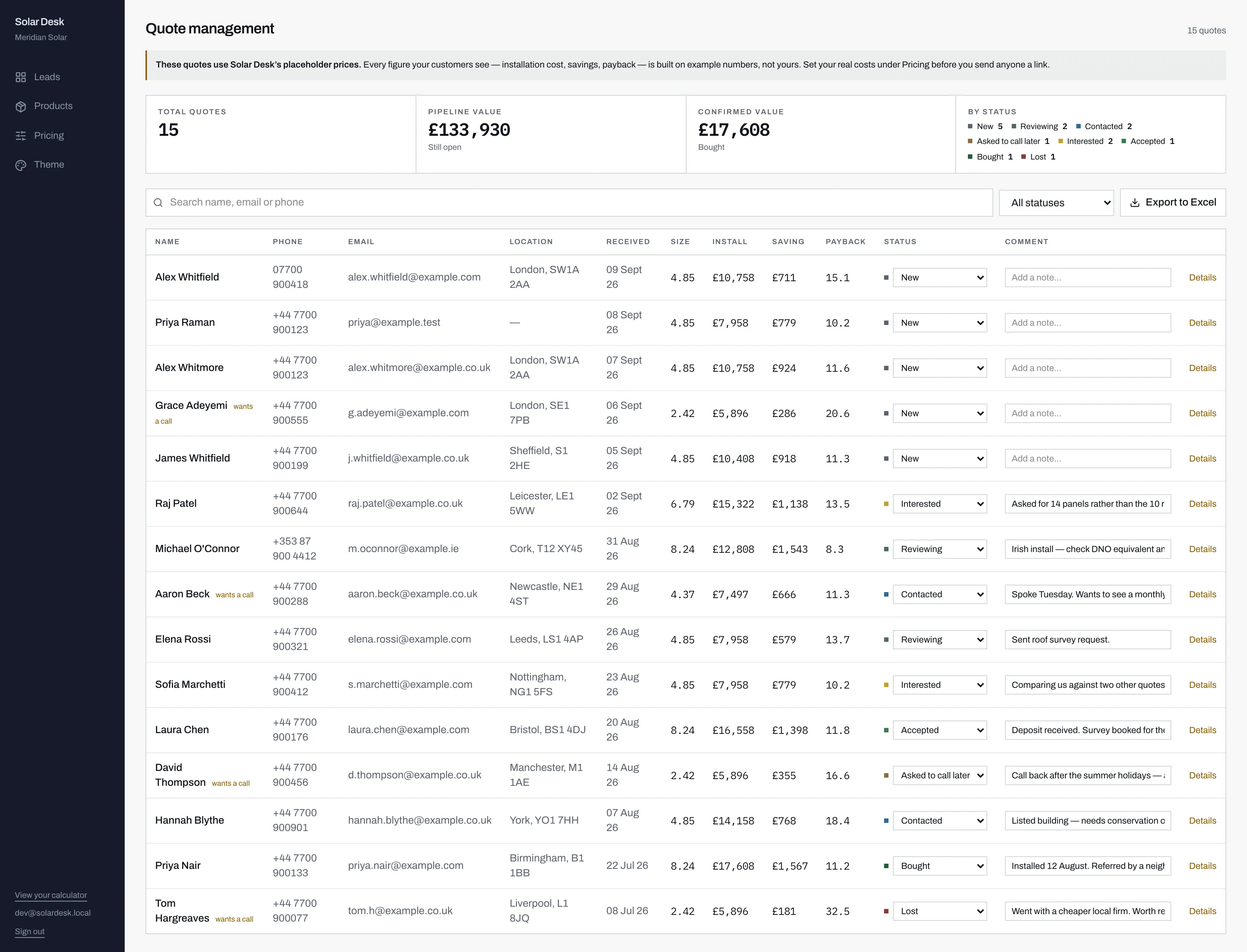
- Pipeline value: the installation cost of every quote still open, added up. It follows whatever filter is on screen.
- Search, status filter and export sit on one line, and all three work off the same filter state.
- Status is a dropdown on the row itself. Changing it saves straight away, without opening the lead.
- The comment box holds the most recent note on that lead. Type over it and you add a new note rather than replacing the old one.
The four figures across the top
Section titled “The four figures across the top”
Pipeline value adds up the installation cost of every lead sitting in a status that counts as open: by default that is New, Reviewing, Contacted, Asked to call later, Interested and Accepted. Confirmed value adds up only the ones marked Bought. Lost counts towards neither.
Two things about that split are worth knowing.
The first is that Accepted counts as pipeline, not as confirmed. A customer clicking “yes” in their account has had no survey, no deposit and no contract. Your confirmed figure only moves when a person at your company records the sale. That is the whole reason the two events are separate, and it is covered on when a quote is accepted.
The second is that the figure comes from the estimate the customer generated, not from any quote you have since written. Editing a quote up or down does not move the pipeline number. If you want the value of your quotes rather than the value of their estimates, export to Excel and sum the column yourself.
Both totals honour the filter. Filter to one status and the row recalculates for that status alone, which is the quickest way to answer “what is sitting in Contacted?”.
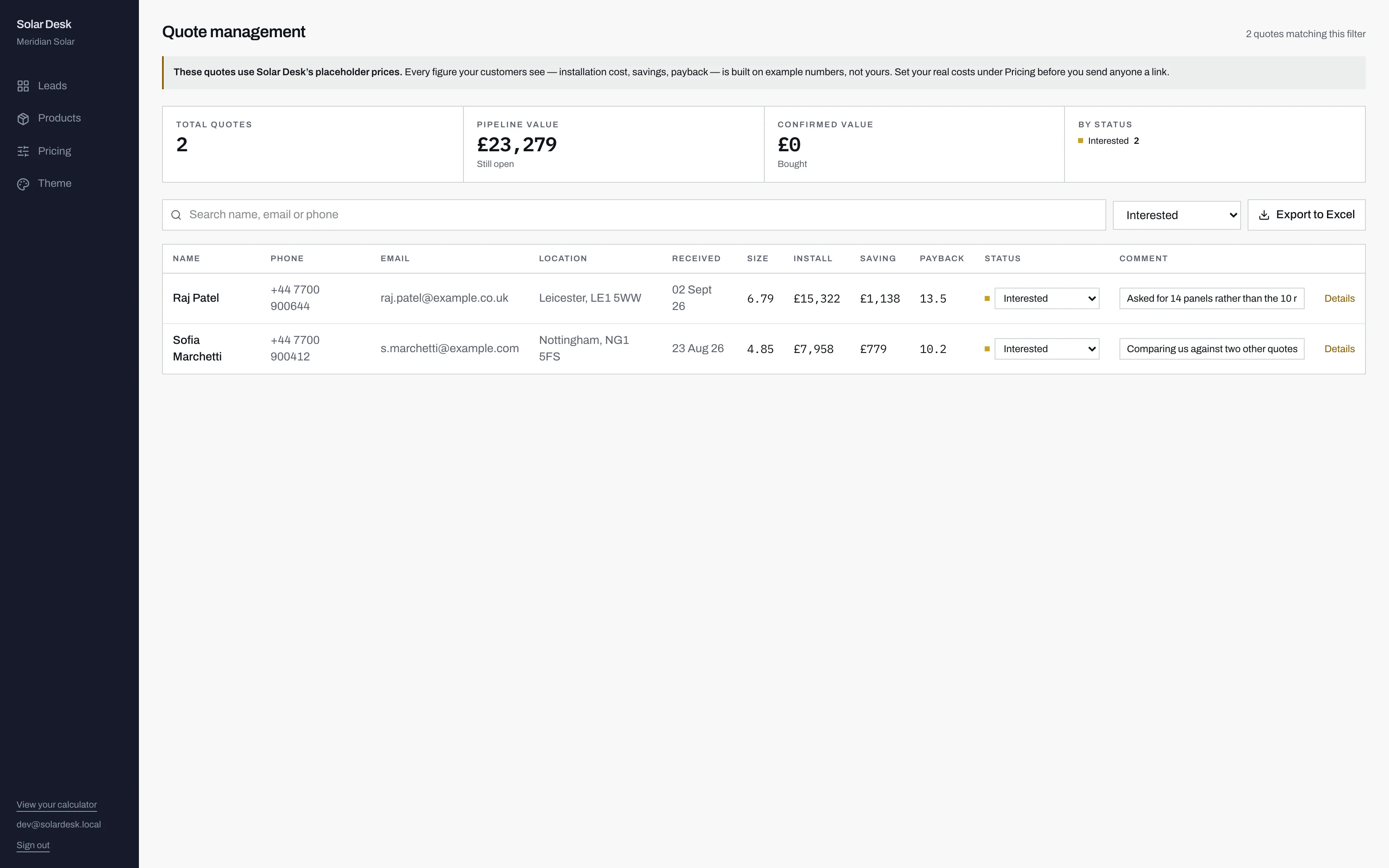
- The count in the corner stops saying how many quotes you have and starts saying how many match.
- Pipeline value is now the value of the Interested leads alone, not of everything still open.
- By status collapses to the one status with anything in it. Empty ones are hidden rather than shown as zero.
- The status dropdown, the only thing narrowed by hand here.
Searching
Section titled “Searching”The search box matches on name, email or phone, case-insensitively, on any part of the value. It waits a moment after you stop typing before it runs, so a long name is one query rather than fifteen.
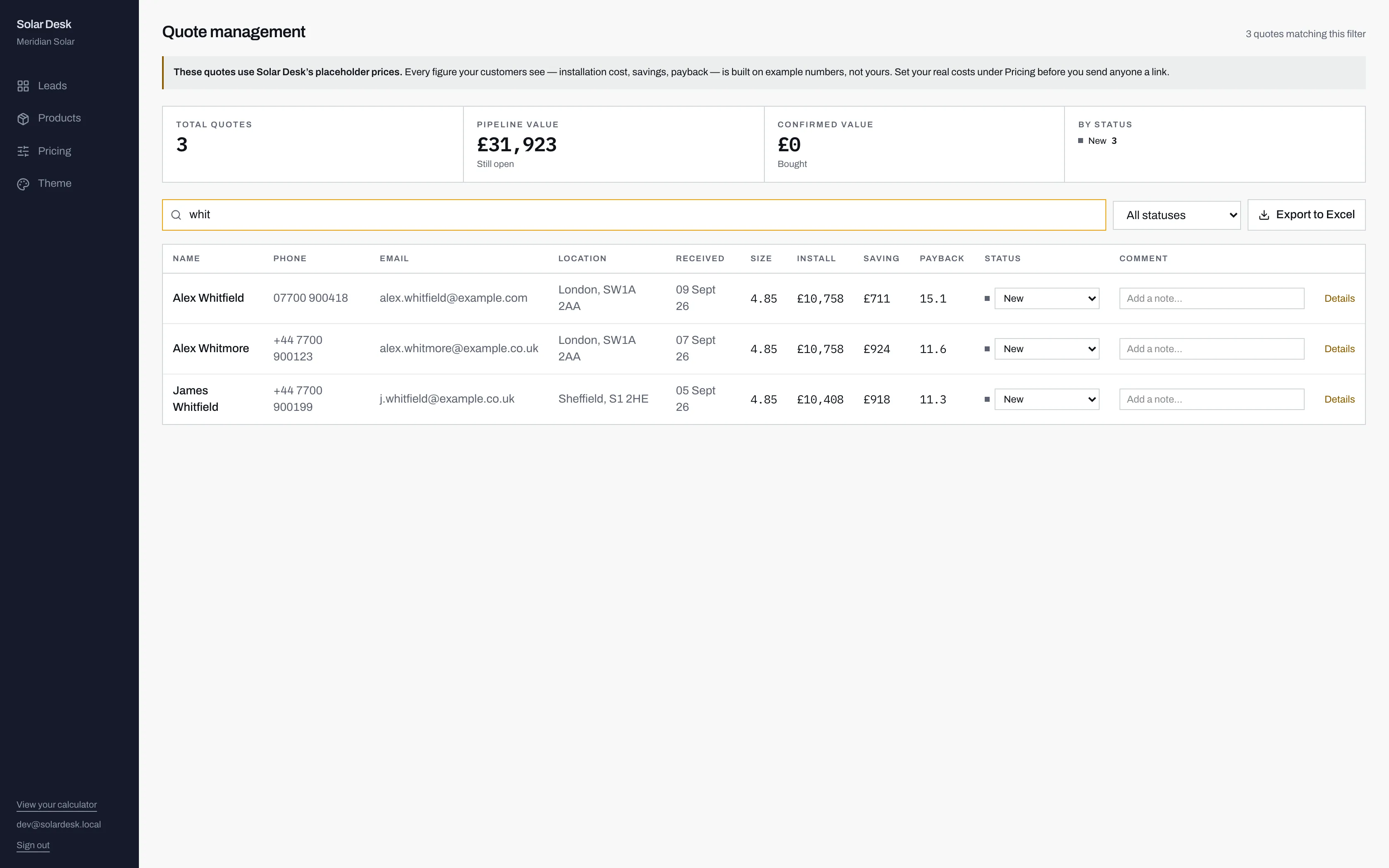
- Searching for whit matches Whitfield and Whitmore, on any part of the name.
- The count in the corner changes to say it is describing a filter, not your whole pipeline.
- The metrics recalculate for the three rows on screen, not for all fifteen.
There is no separate search for an address or a postcode. If you need to find everyone in one town, export and filter in Excel.
A filtered view is a link you can send
Section titled “A filtered view is a link you can send”Filter state lives in the address bar rather than inside the page, which has two useful consequences.
You can copy the URL and send it to a colleague and they see exactly the list you are looking at, assuming they have an account with you. “The three Sheffield ones still in Contacted” becomes a link instead of a description.
And Export to Excel reads the same filter, so the spreadsheet contains the rows on screen and nothing else. Exporting your whole pipeline when you meant to export one status is the kind of surprise that ends with a spreadsheet in the wrong inbox, so the export was deliberately built to follow the screen.
Two badges beside a name
Section titled “Two badges beside a name”- wants a call means they chose “Give me a call” on the last step of the calculator rather than asking for a written proposal. They have questions, and sending a PDF answers none of them.
{n}unread, in amber with a count, means the customer has written to you through their account and nobody on your team has opened the lead since. The count is the number of unread messages, and it clears for everybody the moment any one of you opens the lead.
Editing without opening the lead
Section titled “Editing without opening the lead”Status is a dropdown on the row. Pick a new one and it saves immediately. If the save is refused, for example because your session has expired, the dropdown snaps back to what it was and shows the reason underneath rather than sitting there displaying a change that never happened.

Comment is a text box on the row, saved when you click away or press Enter.
It behaves in one way that surprises people: it is pre-filled with the most
recent note on that lead, but typing over it adds a new note, it does not
edit the old one. Nothing you write here is ever destroyed, and nothing here is
ever seen by the customer. When a lead has more than one, a small “{n} notes”
line appears underneath, and all of them are readable on the lead itself.
That box and the Notes panel on the lead page are the same thread. See notes and messages for the distinction that actually matters, which is between a note and a message.
The columns
Section titled “The columns”| Column | What it holds |
|---|---|
| Name | Links to the lead, plus the “wants a call” and unread badges |
| Phone | As they typed it, or a dash |
| Always present; the calculator requires it | |
| Location | Town and postcode, from the address they picked |
| Received | The date they submitted, not the date they started |
| Size | System size in kWp, to two decimals |
| Install | Installation cost from their estimate |
| Saving | Estimated saving a year |
| Payback | Years to one decimal, or a dash when the system never pays back |
| Status | The inline dropdown |
| Comment | The inline note box |
| Details | Opens the lead |
When nothing matches
Section titled “When nothing matches”An empty result reads “No quotes match this filter yet.” Clear the search box and set the dropdown back to All statuses to get everything back. A brand new account shows the same line, because a brand new account genuinely has nothing in it until somebody finishes your calculator.