Step 2: Your roof
Four questions about the roof itself, and two of them are optional. Nothing here needs a tape measure or a ladder.
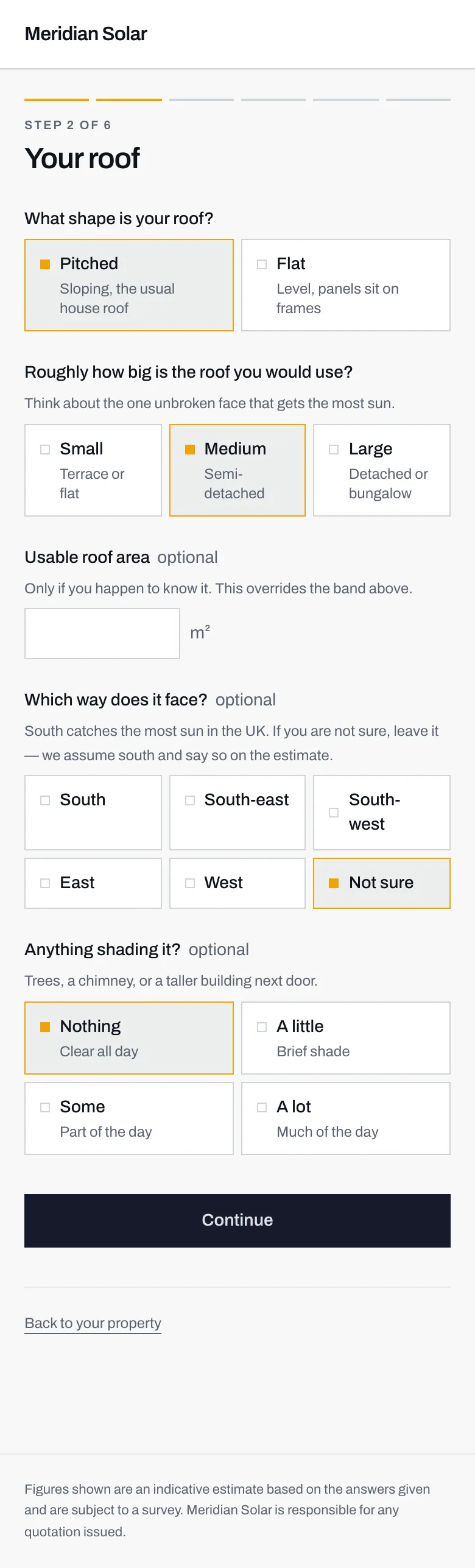
- Pitched means a normal sloping roof. Flat means panels sit on frames instead.
- A size band rather than a measurement. Pick the description that sounds most like your house.
- Only fill this in if you genuinely know the area. It overrides the band above.
- Not sure is a real answer here, and it stays unknown rather than being treated as south.
- Shade is about the roof, not the garden. Think about what falls across the panels, not the patio.
What shape is your roof?
Section titled “What shape is your roof?”Pitched is the usual sloping house roof. Flat is a level roof, where panels have to sit on angled frames instead of lying against the slope. If you are looking at a normal British house, it is pitched.
Roughly how big is the roof you would use?
Section titled “Roughly how big is the roof you would use?”Think about the one unbroken face that gets the most sun, not the whole roof added together. Panels go on in a block, so a single clear face matters more than total square metres spread over four different slopes.
Three bands, each with the kind of house it usually describes:
| Band | Usually means |
|---|---|
| Small | A terrace, or a flat |
| Medium | A semi-detached house |
| Large | A detached house or a bungalow |
The band decides how many panels the calculator thinks will fit, which is why it can later tell you that your roof, rather than your electricity use, is what is limiting the system.
Usable roof area, if you happen to know it
Section titled “Usable roof area, if you happen to know it”An optional box, in square metres. Most people leave it empty, and should. If you have a survey, a plan or a previous quotation that gives a real figure, put it in and it replaces the band above. A guess is worse than the band, because the band is at least an honest approximation.
Which way does it face?
Section titled “Which way does it face?”Optional, and it matters. In the UK, a roof facing south catches the most sun across the day, so it generates the most. East and west faces still work, they just produce less, and more of it at the start or end of the day.
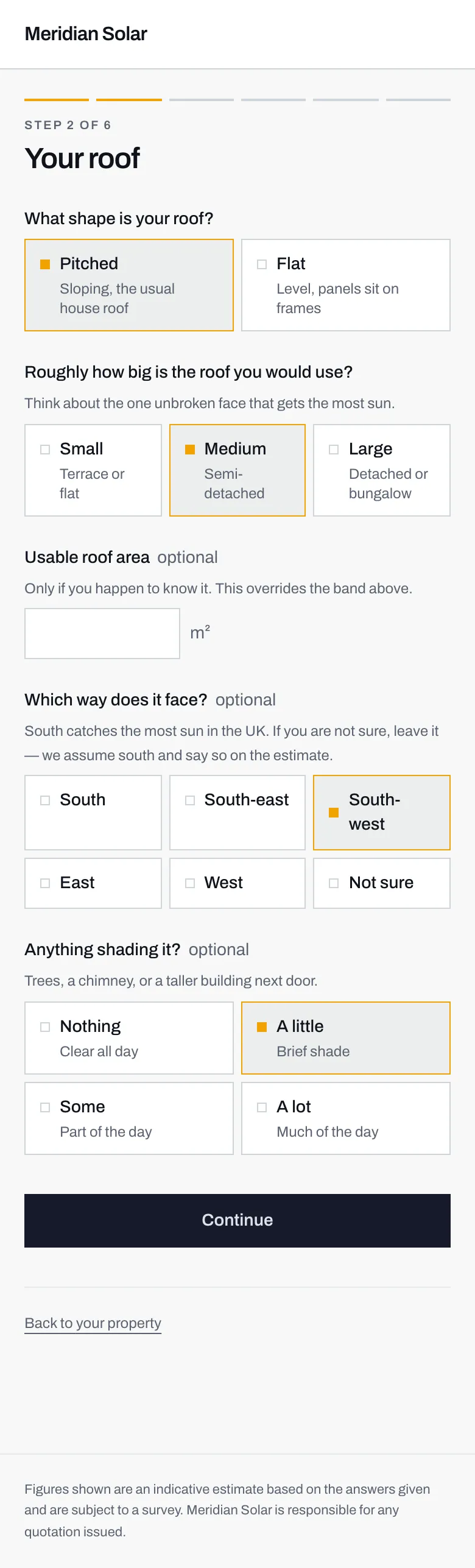
- Here the roof faces south-west, so it catches the afternoon and evening sun.
- A little shade: something clips the roof briefly, but it is clear most of the day.
If you pick Not sure, it stays not sure. The calculator has to assume something to produce a number, so it assumes south, but it says so on your estimate and it tells the installer that you did not know. That is the honest version. It is never quietly recorded as though you had answered south.
Anything shading it?
Section titled “Anything shading it?”Also optional, also worth answering. Shade costs generation, and a roof in shade for much of the day may not be worth panelling at all. Four answers:
| Answer | What it means |
|---|---|
| Nothing | Clear all day |
| A little | Brief shade |
| Some | Shaded part of the day |
| A lot | Shaded much of the day |
The things that usually do it are trees, your own chimney, and a taller building next door. Morning or evening shade matters less than shade in the middle of the day.
Then press Continue.
Next: step 3, your energy use.