The instalment plan
Underneath your four numbers, some installers show a monthly payment plan. It is there so you can see what spreading the cost would look like, not because anyone is offering you a loan.
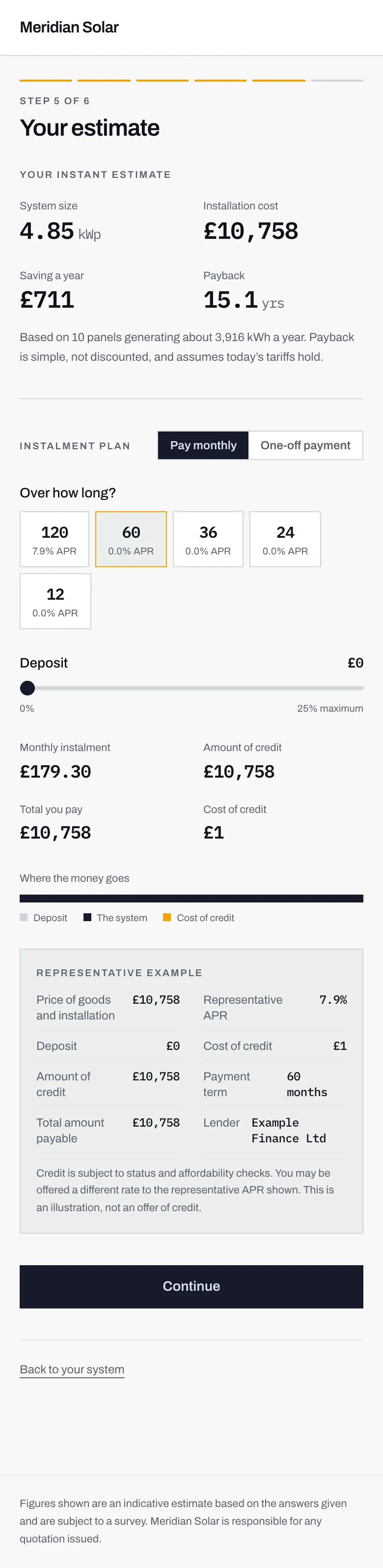
- One button per term, each showing the APR that applies to it. The APR follows the term; it is not a separate choice.
- The deposit slider. More down means less borrowed and a smaller monthly payment.
- Your monthly instalment, worked out to the penny.
- Where the money goes: your deposit, the system itself, and the cost of credit, drawn to scale.
Pay monthly, or pay in one go
Section titled “Pay monthly, or pay in one go”A toggle at the top. One-off payment simply shows the total to pay, and a line pointing out that there is nothing to finance and so nothing to pay in interest.
Whichever you leave selected is saved with your enquiry, so the installer sees what you were actually thinking about. It is worth setting it honestly: a cash buyer and a finance buyer get different conversations, and neither is better.
Over how long?
Section titled “Over how long?”A row of buttons, one per term, each showing the number of months and the APR that goes with it.
APR stands for annual percentage rate. It is the cost of borrowing expressed as a yearly percentage, and it is the number to compare between offers, because it is defined the same way everywhere.
The APR is attached to the term rather than chosen separately. A typical ladder runs a long term at a real rate, with the shorter terms interest-free, which is how most solar finance is sold. Your installer sets their own.
A longer term means a smaller monthly payment and, when the rate is above zero, more interest overall. A shorter interest-free term means larger payments and nothing added on top.
Deposit
Section titled “Deposit”A slider, from nothing up to a ceiling the installer sets. It moves in ten-pound steps.
Putting more down reduces the amount you borrow, which reduces the monthly payment and, on an interest-bearing term, the total interest as well.
The four finance figures
Section titled “The four finance figures”| Figure | What it means |
|---|---|
| Monthly instalment | What leaves your account each month, to the penny |
| Amount of credit | What you would actually borrow, which is the cost minus your deposit |
| Total you pay | Everything, added up: your deposit plus every instalment |
| Cost of credit | What the borrowing costs you, which is the total you pay minus the price of the system |
Under them, a small stacked bar shows the same thing as a picture: how the total splits between your deposit, the system itself, and the cost of credit. On an interest-free term the third band is a sliver, which is the point of showing it.
Why the monthly figure is not APR divided by twelve
Section titled “Why the monthly figure is not APR divided by twelve”If you try to check the sum with a calculator, you will land a penny or two away. That is not a bug, and here is why.
An APR is an effective annual rate, which means it already accounts for interest being charged month by month through the year. To get the monthly rate you take the twelfth root of one plus the APR, rather than dividing the APR by twelve. Dividing overstates the payment slightly.
On top of that, each instalment is rounded up to the whole penny, which is what lenders do so a payment schedule can never end a few pence short. That is also why an interest-free term can still show a pound or so of cost of credit: sixty payments each rounded up by a fraction of a penny add up to a small amount that has to appear somewhere.
The representative example
Section titled “The representative example”At the bottom, a bordered block headed Representative example. It restates the whole thing in one place: the price of the goods and installation, the representative APR, the deposit, the cost of credit, the amount of credit, the payment term, the total amount payable, and the lender’s name.
An installer showing finance cannot switch this block off. Quoting a monthly payment and a rate is a regulated financial promotion in the UK, and the example is part of what makes it one you can check rather than one you have to trust.
Underneath it sits this footnote:
Credit is subject to status and affordability checks. You may be offered a different rate to the representative APR shown. This is an illustration, not an offer of credit.
If you see no finance section at all
Section titled “If you see no finance section at all”Some installers are not authorised to offer credit, and their calculator simply does not show any of this. The estimate ends at the four numbers. That is a deliberate setting on their side, not something missing from yours.
Next: what the estimate is not.