The four numbers
Your estimate comes down to four figures. None of them is complicated once somebody tells you what it means, and nobody usually does.
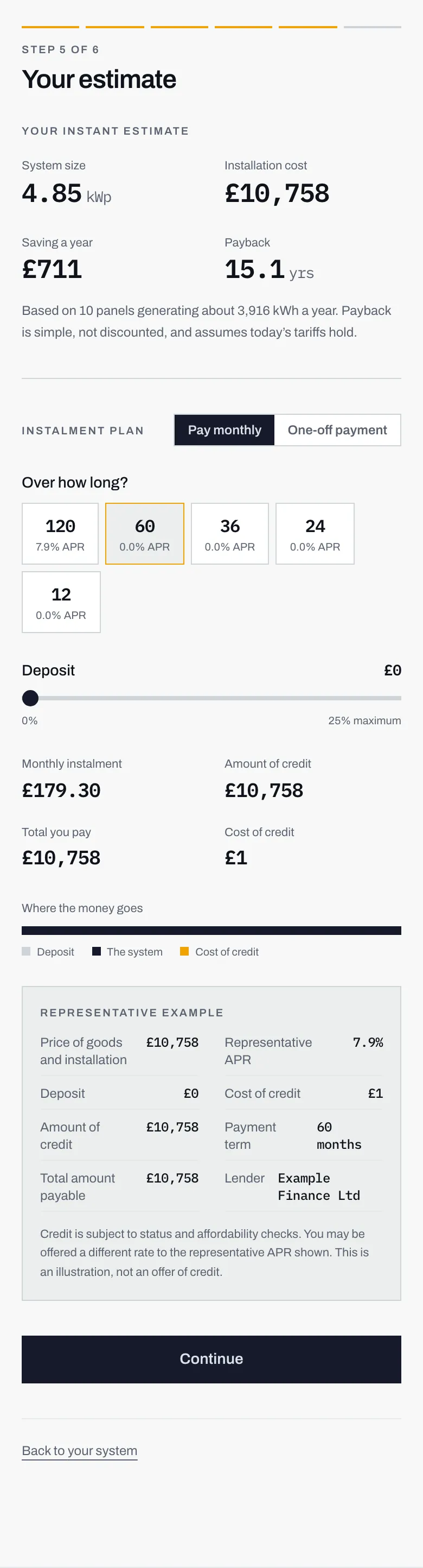
- System size, in kWp. How big the system is.
- Installation cost. What you would pay to have it put in.
- Saving a year. What comes off your electricity bill.
- Payback. How many years of that saving covers the cost.
System size, in kWp
Section titled “System size, in kWp”kWp stands for kilowatt peak. It is how much electricity the system would produce at one moment in bright, ideal conditions, and it is the standard way the trade describes the size of an installation.
Think of it as the engine size of your solar system. It does not tell you how far you will drive, only how much power there is under the bonnet.
Two things decide it: how many panels fit, and how powerful each panel is. Ten panels rated at 485 watts each come to 4.85 kWp, because a kilowatt is a thousand watts.
You will see it written to two decimal places, like 4.85 kWp. That precision is about arithmetic, not accuracy: a survey may well change the panel count.
Installation cost
Section titled “Installation cost”What you would pay to have the system supplied and fitted. It is not the price of the panels. It includes the scaffolding, the labour, the inverter (the box that turns what the panels make into the sort of electricity your house uses), the mounting, the paperwork with your electricity network operator, and the certification at the end.
If you added a battery, its cost is in here too, along with any extra for mounting it outside.
One thing worth knowing: the cost per kWp falls as the system gets bigger. The scaffolding, the paperwork and the day’s labour are much the same whether you fit six panels or twelve, so twice the system does not usually cost twice as much.
Saving a year
Section titled “Saving a year”What the system takes off your electricity bill in a typical year, in pounds.
It is made of two different things added together, and they are worth a lot differently:
- Electricity you use yourself instead of buying it. This is worth your full unit rate, whatever you pay per kWh. It is the valuable half.
- Electricity you export, meaning the surplus your house does not need at the moment it is generated, which goes back into the grid. You are paid for it, but considerably less than you pay to buy electricity.
That gap is why a battery changes the figure, and why a system much bigger than your own consumption stops being worth it: past a certain point you are just generating electricity to sell cheaply.
Payback
Section titled “Payback”The number of years it takes for the yearly saving to add up to the installation cost. Cost divided by saving, in other words.
It is deliberately the simple version. It does not adjust for electricity prices rising, for inflation, or for what your money might have earned elsewhere. The estimate says so on the page: payback is simple, not discounted, and it assumes today’s tariffs hold.
Take it as a rough rank rather than a prediction. It is genuinely useful for comparing one configuration against another, which is what the slider on step 4 is for, and much less useful as a promise about the year 2041.
What is not in any of them
Section titled “What is not in any of them”No grants, no VAT changes, no maintenance, no inverter replacement partway through the system’s life, and no allowance for your electricity use changing. An estimate is a starting position, not a business case.